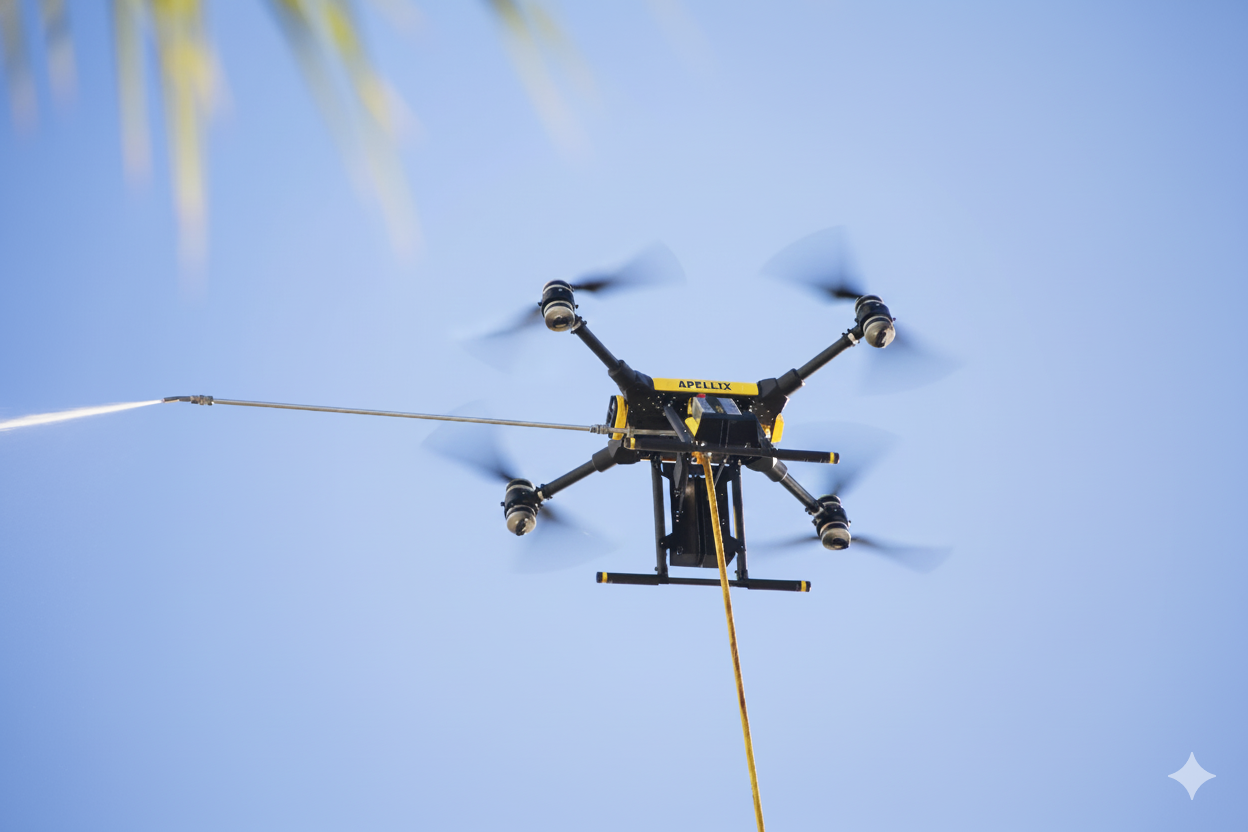
Our systems typically clean up to 20 stories (approx. 190–210 feet). Special hose-assist designs can sometimes extend this even further while remaining within FAA limits.
Generally, yes. We typically require access to a standard garden hose hookup,
For remote sites, we can arrange for portable water tanks and generators.
Every job site includes a designated ground hazard zone. We use spotters to monitor the perimeter and ensure no one enters the area beneath the drone's flight path.
handle all regulatory hurdles, including obtaining LAANC authorizations for near-airport flights or filing for specific FAA waivers when working in restricted airspace.
Yes, all operators hold a Part 107 Remote Pilot Certificate. This is a federal requirement for any commercial drone operation in the U.S..
Yes, we use "soft washing" techniques. This combines eco-friendly, biodegradable solutions with low-pressure water to safely remove grime, algae, and mold without damaging delicate surfaces like stucco or shingles.
We carry specialized aviation liability insurance in addition to standard general liability. This specifically covers the unique risks of operating unmanned aircraft near high-value structures.
Yes, we do. While NYC has some of the strictest drone regulations in the country, we are fully equipped to service all five boroughs. Since July 2023, the city has opened a specific permitting process that allows for commercial drone operations like building facade and window cleaning.
Sustainable Skyscrapers: How Technology is Reducing the Carbon Footprint of Maintenance
As local governments across the Tri-State area implement stricter "Green Building" standards, every aspect of property management is under the microscope—including how we wash the windows.
Water Conservation
Traditional pressure washing is notoriously wasteful, often using thousands of gallons of water that simply runs off into the storm drains.
Precision Targeting: Because a drone can get closer to the surface and maintain a perfect angle of attack, it requires 30-50% less water to achieve the same (or better) results than a technician on a lift.
Chemical-Free Cleaning
By utilizing the power of deionized water and high-pressure precision, Airion Clean can often eliminate the need for harsh chemical detergents. This prevents toxic runoff from entering the local ecosystem—a major concern for buildings located near the Hudson River or coastal areas of the Tri-State.
The Future of the Facade
The "Looking Ahead" philosophy at Airion Clean is about more than just technology; it’s about stewardship. Our buildings are the most visible part of our cities. Maintaining them shouldn't come at the cost of safety or the environment. By choosing drone technology, property owners are signaling that they are ready for the future—a future where maintenance is smart, safe, and sustainable.
.svg)
The Hidden Costs of Scaffolding: Why Drones are a Financial Game-Changer
For a property manager in NY, NJ, or PA, "cleaning the building" is often the smallest part of the budget. The real costs are hidden in the logistics, the liability, and the lost time.
The Permit and Sidewalk "Tax"
In dense urban environments, traditional access requires sidewalk bridges and scaffolding permits. These costs add up daily. Furthermore, scaffolding is a "static" cost—you pay for it while it sits there, even on rainy days when no work is being done.
The Drone Advantage: Airion Clean has a "mobile footprint." We arrive in a specialized trailer, deploy, and leave the same day. There is no permanent structure left behind, meaning no ongoing permit fees and no "scaffolding eyesore" for your high-paying tenants.
Insurance and Risk Mitigation
"Working at Height" is the highest-risk category for insurance providers. When you hire a crew to hang from a swing stage, your building's liability profile increases.
The Shift: By moving the human element to the ground, we effectively "de-risk" the job site. If a drone has a mechanical failure, it is a piece of equipment that is damaged—not a human life. This safety shift is increasingly being recognized by insurance carriers as the preferred method for modern facade maintenance.
Tenant Retention and Privacy
In luxury residential or high-end commercial buildings, tenants value two things: the view and their privacy. Scaffolding blocks the view for weeks, and workers hanging outside windows can feel intrusive. Drones move quickly and quietly, completing the job with minimal visual or auditory impact on the people inside.
Precision at Altitude: The Engineering Behind Industrial Cleaning Drones
When most people think of a drone, they imagine a lightweight hobbyist camera flying through a park. However, the systems used by Airion Clean to maintain mid-to-high-rise facades in the Tri-State area are industrial-grade heavy-lift aircraft. Understanding the physics of how these machines operate is key to understanding why they are superior to a traditional pressure-washing crew.
1. Overcoming the "Recoil" Problem
The primary challenge of drone cleaning is Newton’s Third Law: for every action, there is an equal and opposite reaction. When a high-pressure nozzle shoots water at a building, the force pushes the drone backward.
The Solution: Our drones utilize Active Thrust Compensation. The flight controller is synced with the water pump. The moment the trigger is pulled, the drone’s rotors automatically tilt and increase RPMs to create a forward "counter-thrust." This allows the drone to hover perfectly still, maintaining a consistent 12-to-18-inch distance from the glass.
2. The Role of Deionized (DI) Water
We don't just use standard tap water. Mineral-heavy "hard" water leaves spots and streaks when it dries.
The Science: We use a multi-stage filtration system to strip water of all minerals (calcium, magnesium, etc.), bringing the Total Dissolved Solids (TDS) count to zero.
The Result: This "hungry" water aggressively attracts dirt and grime on a molecular level. Because there are no minerals left in the water, it evaporates completely, leaving a spot-free, "squeegee-clean" finish without a technician ever touching the glass.
3. Tethered Power and Fluid Systems
Battery life is the enemy of efficiency. To clean a 20-story building, a drone needs constant power and a massive volume of water.
The Setup: Our drones are tethered. A high-strength umbilical cord runs from the drone down to our custom trailer. This line provides a continuous flow of pressurized water and a constant stream of high-voltage electricity. This allows our pilots to stay in the air for hours, completing in one morning what would take a scaffolding crew an entire week.


.webp)
.webp)